



Why Stars Like Diplo, Gunna and Travis Barker Are Hitting the Road — With Their Own Run Clubs

Trending on Billboard
Gunna says that, three years ago, he could only run “like, half a mile,” before stopping to catch his breath. At the time, he’d just completed a seven-month jail sentence after pleading guilty to one count of racketeering conspiracy; he was “just trying to get my mental together and block out all the mess, all the media and all the life problems.”
Even those half miles helped, though. Ultimately, he “fell in love with” running. “I see the results,” he says. “I feel better. I’m thinking better. My career is starting to move better.”
Cut to the fall of 2025, and Gunna had amped up his mileage significantly. That September, he launched Gunna’s Wunna Run Club, a traveling 5K that’s now hosted races in nine cities including New York, Toronto and Johannesburg, where thousands of people turned out in early January to run alongside the rapper himself.
“My fans are not just my music consumers; they’re my life consumers too,” he says. “I had to give them this knowledge. They deserve it.”
Plenty of musicians run; maybe it’s unsurprising that an artist used to plugging away in the studio for hours on end would have the stamina the activity demands. But Gunna is one of several across genres who have now parlayed their favored form of fitness into something bigger: an actual run club.
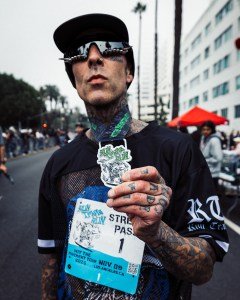
Travis Barker’s Run Travis Run event launched in late 2025 with 5Ks in Chicago, Las Vegas, Los Angeles and Palm Desert, Calif. Diplo reports that his Diplo’s Run Club — which just hosted 5K run-and-raves in Miami and Phoenix in mid-January — has sold 100,000 tickets across 10 events that began in the fall of 2024. And Jelly Roll has his own Losers Run Club, a primarily online community with a mission, its official site states, “to help those who are traditionally underserved in the running community hold each other accountable, with the end goal of changing their life through hard work and moving their body.” (Participants are no doubt inspired by the country-rap star’s own recent 275-pound weight loss.)
For Barker, running is a deeply personal pursuit: It helped him get sober in 2008. “Not being athletic, it was the thing I knew I could do on my own,” the legendary blink-182 drummer says. “I didn’t need any equipment. No excuses.” He can now run a 5K in 19 minutes and says he gets so excited about races that he has trouble sleeping the night before. “It’s so therapeutic,” Barker says. “Like, God gave you running.”
Diplo started running while on his high school wrestling team in Florida, later finding it not only made him feel good but suited the peripatetic lifestyle he follows as a superstar DJ and producer. “No matter what city you’re in, no matter where you live, there’s always a place to run,” he says. “I’ve run in Guatemala; I’ve run in Antarctica. You don’t even really need shoes.”
He sees running as “one thing you can do every day to reduce anxiety and depression, even a tiny bit. There’s so much going on in your world you can’t control. The only thing you really have control over is how your body feels.”

It’s a point he emphasizes at precisely 9 a.m. on a recent sunny Saturday in Phoenix, moments before he takes off running down the street, leading a horde of roughly 10,000 spandex-sporting fans behind him. Some flew in for this run from Seattle, Denver and points beyond, while some live across the street from the park where it’s happening. Twenty-one minutes later, Diplo crosses the finish line, and two hours after that, he’s onstage playing EDM classics for a packed crowd. (The set includes him doing a gender reveal for a member of the audience. “It’s a boy!” he yells to the cheering crowd before dropping Disco Lines and Tinashe’s “No Broke Boys.”)
Diplo’s Run Club is, like Gunna’s and Barker’s groups, another platform for both art and business. Barker’s events either bring in local acts to play near the finish line — “I envision it being a mini-music festival and 5K,” he says — or happen the same day he’s performing in town. Wunna Run Club runs happen in the mornings, and Gunna performs that night, while Diplo and a rotation of opening DJs play sets near the finish line of every run club event. “They’re more euphoric than a proper festival, where everybody’s crammed in there and on their last pills, like, drinking vodka out of a CamelBak,” he jokes of these shows, adding that real ravers are typically quite fit anyway, given all the dancing they do.
Good vibes aside, convincing city officials to enact street closures for race routes is a complicated and often political process, and the margins on these events are typically low. So why are these artists making a run for it?
Like Barker and Diplo, Gunna emphasizes that most crucially, Wunna Run Club is a way to share something that’s benefited him with his fans. “I had to tell them, give them that knowledge, build the community,” he says. “As people, we battle with health problems, so I feel like this is me giving them a starter kit to be healthy.” Recently, one fan showed him before and after photos of her 100-pound weight loss, saying he helped inspire the transformation. “It just felt like I was doing something right,” Gunna says.
Likewise, Barker urges that Run Travis Run is not intended to “be discouraging or make people feel like they have to be some superstar athlete to participate. There are a lot of people that show up who’ve never walked or run a 5K in their life.” Diplo says that after he finishes the race, he often circles back to high-five participants who are still out there running and walking. “They try it, do it, and that’s a huge breakthrough for those people.”
The run club model, he says, is also in part a way to bring dance music to people who might never go to the club or who’ve aged out of the scene’s late-night schedule. “Clubbing is a young man’s game,” says Diplo’s longtime agent at Wasserman Music, Sam Hunt. “Going to [Miami nightclub] Space at three in the morning — I can confirm. Providing a place where you can have a few drinks, dance, hang out and party with your friends — but it’s nine or 10 in the morning and there’s a fitness element — unlocks a world of possibilities for thousands of people.” Runs also tend to draw as many running fanatics as music fans, bringing a new demographic into each artist’s orbit. Diplo says he’s also working on new music made expressly for running, calling his run club “a great vehicle to release an album.”
Diplo’s team, which includes Hunt and Renee Brodeur, his co-manager at TMWRK, produces run club events independently of any concert promoter like AEG or Live Nation, instead partnering with Oakland, Calif.-based run producer Mascot Sports. Experts in key elements like road closures and staffing, Mascot is also partnered with Run Travis Run and Wunna Run Club.
“In the beginning, I thought I could just tweet or post something on my Instagram and watch people come,” Barker says. “Then I found out there were all these liabilities and insurance and road closures you have to worry about if there’s x amount of people.”
Diplo’s Run Club hosts 10,000 to 15,000 people at each event, which Hunt says “is a hard profit and loss prospect. Renting a space in the park or whatever, fencing it off, bringing in power, staging, bathrooms and vending, the cost of doing that doesn’t usually net out against what you can bring in.”
He and the team created a money-saving hack by sharing run club venues — often city parks with epic views — with an event happening at the same site the night before or after. For the L.A. run club last October, the team linked with Goldenvoice, which was hosting a show by electronic producer Mau P at the Los Angeles State Historic Park the night prior.

“Normally that would end at 12 a.m. and they’d tear the site down,” Hunt says. “We made a deal with Goldenvoice that instead of tearing that event down at midnight, they’d keep everything up until 1 p.m. the next day, we’d use it for our event the next morning, then they could take everything down.” In Phoenix, the Mascots Sports team had traffic flowing back on the run route almost immediately after the last runner crossed the finish line.
But while turning a profit can be tricky (Barker says he actually loses money on run club events), there are unique sales opportunities, too.
“Runner’s high is a real thing,” Hunt says. “You get a very energized, excited audience. They drink a lot; they eat a lot; they buy a lot of merch.” At the debut run club at Golden Gate Park in San Francisco in September 2024, the biggest issue was that the bars were understaffed. “The event is basically two hours long after the race ends,” Hunt says, “but we [sell] as much food and beverage as a five- or six-hour event would normally do.”
Sponsorships also help offset costs while exposing artists to new demographics and vice versa. “There’s a lot of demand for sponsors and brands to be involved,” Hunt says, “and a lot of brands in the health and wellness space that are interested in these audiences.”
To wit, Wunna Run Club participants all leave with products from Under Armour, the hydration drink Flerish, PATH water, the running app STRAVA (where Diplo and Gunna both post their runs) and supplement maker Cymbiotika. At Diplo’s events, Hunt says “the lines to engage with the sponsor booths are as long as the bar lines.”
Diplo has also benefited from becoming more ingrained in the running world; he’s now an ambassador for the biometric monitoring device Whoop and has appeared in a Whoop campaign alongside soccer idol Cristiano Ronaldo. “That would probably not have happened if he didn’t have these runs,” co-manager Brodeur says.
For Diplo, too, the benefit isn’t just brand partnership dollars but building a new event that could be licensed to “operate without me. I don’t have to be at all the run clubs.” (He has, thus far, played at and run in every event.)
Each of these run clubs also weaves in charitable initiatives. Donations are partially raised by the cost of participation, with Wunna Run Club charging $75 per person, Run Travis Run beginning at $85 and Diplo’s Run Club starting at $100. Prices go up for tiers offering perks like the chance to run alongside Barker and Diplo and VIP sections that not only offer better vantage points to see the stage but also back rubs, foot massages and ice baths.
Diplo’s Run Club donates a portion of every ticket sale to Good Sports, a nonprofit creating equitable access to youth sports. (Each run benefits youth sports projects in its respective city.) Gunna and his team use money raised for his Gunna’s Great Giveaway, which benefits communities in his hometown of South Fulton, Ga., while money raised through Run Travis Run goes to Community Organized Relief Effort, which benefits communities in crisis around the world.
Each artist has plans to keep it moving. Gunna says his “real goal” is to host his own marathon, which will likely happen in September. The next slate of Run Travis Run 5Ks will be announced in the coming weeks, and Diplo and his team are working to expand his run clubs to Chicago, Denver, Toronto and Mexico City in the near future and Europe in the longer term. Diplo also envisions a hypothetical race with Barker, Gunna and Jelly Roll, with the winner getting $100,000 to give to his favorite charity.
Whether or not that happens, there’s already a lot to feel good about, from enhanced heart rate variability to enhanced legacies. “I wanted to do something I could be proud of from a general-population point of view,” Diplo says. “I’ve never had so many people thank me for starting a project.”
This story appears in the Feb. 7, 2026, issue of Billboard.